



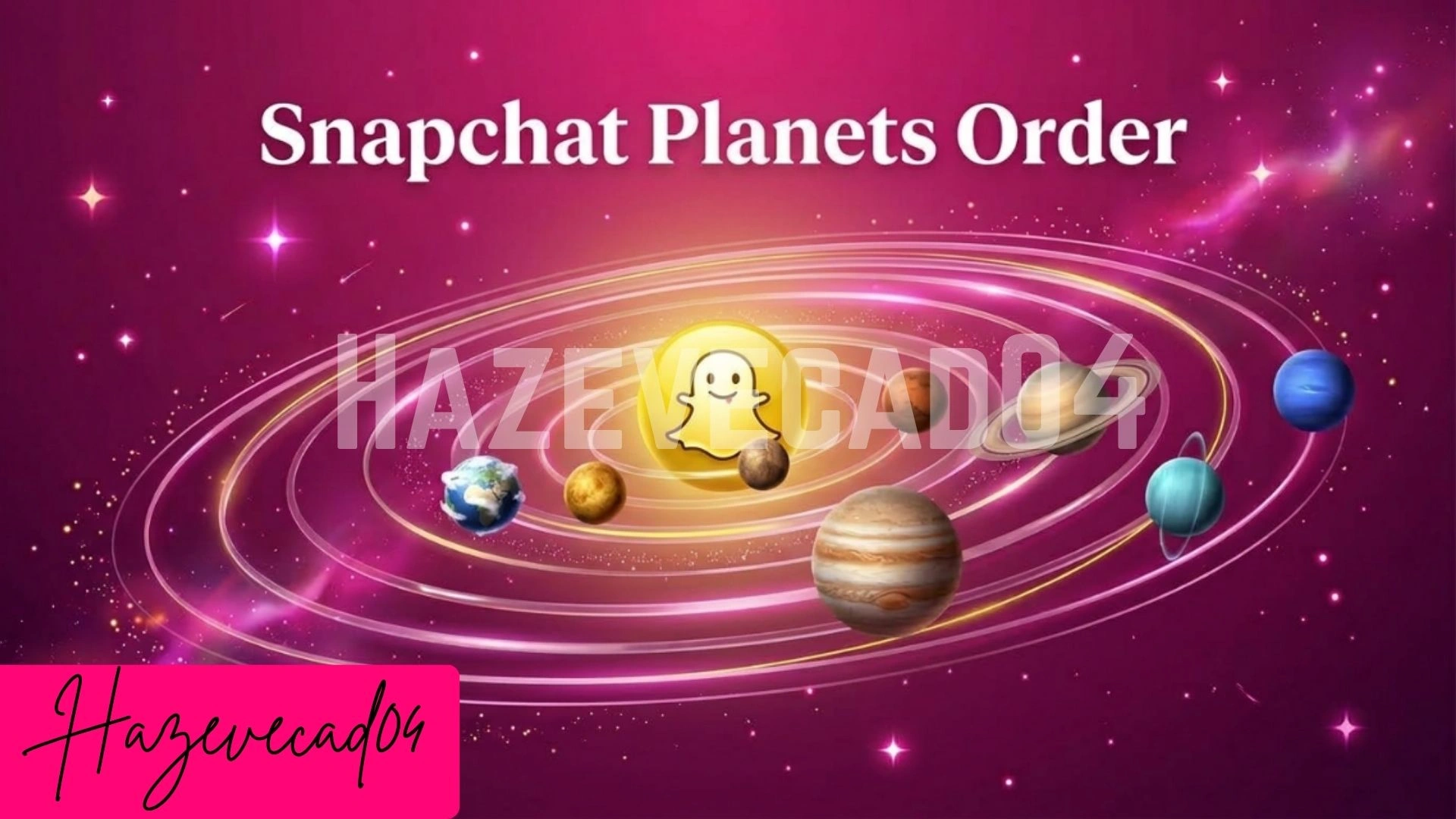
Snapchat’s Friend Solar System turns friendships into a visual ranking.
The clever part is simple: Mercury means #1, while Neptune means #8.
| Planet | Position | What It Represents |
|---|---|---|
| Mercury | #1 | Highest Best Friends position |
| Venus | #2 | Second position |
| Earth | #3 | Third position |
| Mars | #4 | Fourth position |
| Jupiter | #5 | Fifth position |
| Saturn | #6 | Sixth position |
| Uranus | #7 | Seventh position |
| Neptune | #8 | Eighth position |
Snapchat officially calls this feature Friend Solar Systems. It is available through Snapchat+. Snapchat says the planets represent positions among your Best Friends.
What Is the Snapchat Planet Order?
The Snapchat planet order follows our actual solar system. The sequence starts with Mercury and ends with Neptune.
That creates eight friendship positions. Your friend’s position determines the planet shown to you.
Mercury → Venus → Earth → Mars → Jupiter → Saturn → Uranus → Neptune
Snapchat’s official support page confirms all eight planets. It also explains that each planet represents a different Best Friends position.
The Ranking in One Line
Mercury = #1 → Venus = #2 → Earth = #3 → Mars = #4 → Jupiter = #5 → Saturn = #6 → Uranus = #7 → Neptune = #8
This is the easiest way to memorize the system.
Mercury to Neptune: The Full Meaning
1. Mercury — #1 Position
Mercury represents the first position.
You are therefore the person’s highest-ranked friend in this system. Snapchat places Mercury closest to the Sun because it is first in the planetary sequence.
This does not automatically describe your real-life relationship. It reflects your position within Snapchat’s Best Friends system.
2. Venus — #2 Position
Venus represents the second position.
You rank immediately behind the Mercury position. The planet therefore indicates a very high position within the available Best Friends ranking.
The important detail is the number two ranking, not a special personality type.
3. Earth — #3 Position
Earth represents position number three.
If someone sees you as Earth, you occupy the third position in their Friend Solar System.
That still places you among the highest-ranked positions represented by the feature.
4. Mars — #4 Position
Mars represents the fourth position.
It sits in the middle of Snapchat’s eight planetary positions. Your placement means you rank fourth within that person’s Friend Solar System.
It does not officially mean you are a “less important” friend.
5. Jupiter — #5 Position
Jupiter represents position number five.
This position remains inside Snapchat’s eight-planet system. However, four positions appear before it.
The key fact is therefore simple: Jupiter means #5.
6. Saturn — #6 Position
Saturn represents the sixth position.
It comes after Jupiter and before Uranus. Your planet placement can change as your Snapchat friendship ranking changes.
Snapchat does not publicly define Saturn as a particular type of personal relationship.
7. Uranus — #7 Position
Uranus represents position number seven.
Only Neptune comes after it in the Friend Solar System. Therefore, Uranus is the second-lowest planetary position available.
Again, the planet should be read as a ranking indicator.
8. Neptune — #8 Position
Neptune represents the eighth position.
It is the final planet in Snapchat’s Friend Solar System. Seeing Neptune does not mean someone is not your friend.
It simply means you occupy position eight within that particular ranking.
How Does Snapchat Decide Your Planet?
This is where many online explanations become too specific.
Snapchat officially says Best Friends are people among the eight friends you Snap and Chat with most. The Friend Solar System then shows a planet for each position.
Snapchat does not publish a complete public formula for every ranking factor. Therefore, claims about exact point values or fixed interaction percentages should not be treated as official.
What can safely be said is:
- Best Friends can include up to eight people.
- Your interactions affect the Best Friends ranking.
- Each position receives a planet.
- Mercury represents position one.
- Neptune represents position eight.
- Rankings can change as your Snapchat activity changes.
Snapchat also says its Chat ordering reflects who you keep in touch with most and who contacted you most recently. That helps explain why Snapchat’s social rankings can change over time.
A Detail Many Users Miss
Your planet and your friend’s planet are not necessarily identical.
For example, you might appear as Mercury in someone’s Solar System. That means you hold their #1 position.
It does not automatically mean they hold your #1 position.
This distinction matters because Friend Solar Systems represent each account’s own ranking. A friendship can therefore look different from each side.
Example
Imagine four friends:
| Person | Your Position |
|---|---|
| Alex | Mercury #1 |
| Sara | Venus #2 |
| Hamza | Earth #3 |
| Bilal | Mars #4 |
Now imagine Alex’s Solar System.
You could appear as Alex’s Mercury. Alex might appear as your Venus instead.
The two rankings can differ.
Why Does Snapchat Use Planets?
The design borrows an idea users already understand.
In the real solar system, Mercury is closest to the Sun. Neptune is the farthest of the eight planets.
Snapchat turns that familiar order into a social interface. The closer the planet position, the higher the Best Friends position.
This makes a complicated ranking easier to understand visually. Users do not need to remember eight numerical labels.
Snapchat+ and the Friend Solar System
The Friend Solar System is a Snapchat+ feature. Snapchat lists Solar System among the features included with its subscription.
There is another useful detail here.
Snapchat says Solar System is off by default for first-time subscribers. Users can enable or disable it through Snapchat+ feature management.
How to Check Your Planet
To check your position, Snapchat’s system works through a friend’s Friendship Profile.
Look for the Best Friends badge with a gold ring. Tap the badge to see your planet position in that person’s Solar System. Snapchat describes this process directly in its support documentation.
Snapchat Planets vs Real Friendship
A planet ranking should not be treated as a complete friendship measurement.
Snapchat is showing a platform-based ranking. It is not measuring trust, loyalty, emotional closeness, or friendship quality.
Someone can be your Mercury because you interact frequently. Another person could be your closest real-life friend without appearing in the top eight.
That distinction prevents unnecessary confusion.
What the Planet Can Tell You
- Your position within the Friend Solar System.
- Whether you are inside the represented top eight.
- How your position compares with other planets.
- How your Snapchat ranking may change over time.
What It Cannot Prove
- Who cares about you most.
- Who your best real-life friend is.
- Whether someone likes you romantically.
- Whether a friendship is emotionally strong.
- The exact number of Snaps needed for each position.
These interpretations go beyond what Snapchat officially confirms.
The Easiest Way to Remember Snapchat Planets
If you keep forgetting the order, remember this phrase:
M V E M J S U N
Then expand it:
Mercury → Venus → Earth → Mars → Jupiter → Saturn → Uranus → Neptune
The numerical shortcut is even easier:
| Rank | Planet |
|---|---|
| 1 | Mercury |
| 2 | Venus |
| 3 | Earth |
| 4 | Mars |
| 5 | Jupiter |
| 6 | Saturn |
| 7 | Uranus |
| 8 | Neptune |
There is no Pluto position because Snapchat’s system uses the eight planets.
Final Takeaway
The Snapchat planets order is straightforward once you understand the concept. Mercury represents #1, while Neptune represents #8.
The most important point is not the planet’s color or appearance. The planet represents your position within another person’s Snapchat Best Friends ranking. Snapchat officially confirms the eight-planet system and its connection with Best Friends.
For accuracy, avoid treating unofficial interaction percentages as Snapchat rules. The company has not published a complete formula explaining every detail behind the ranking.
Read more : TozyMagazine.com: What Is This Online Magazine Really About?